
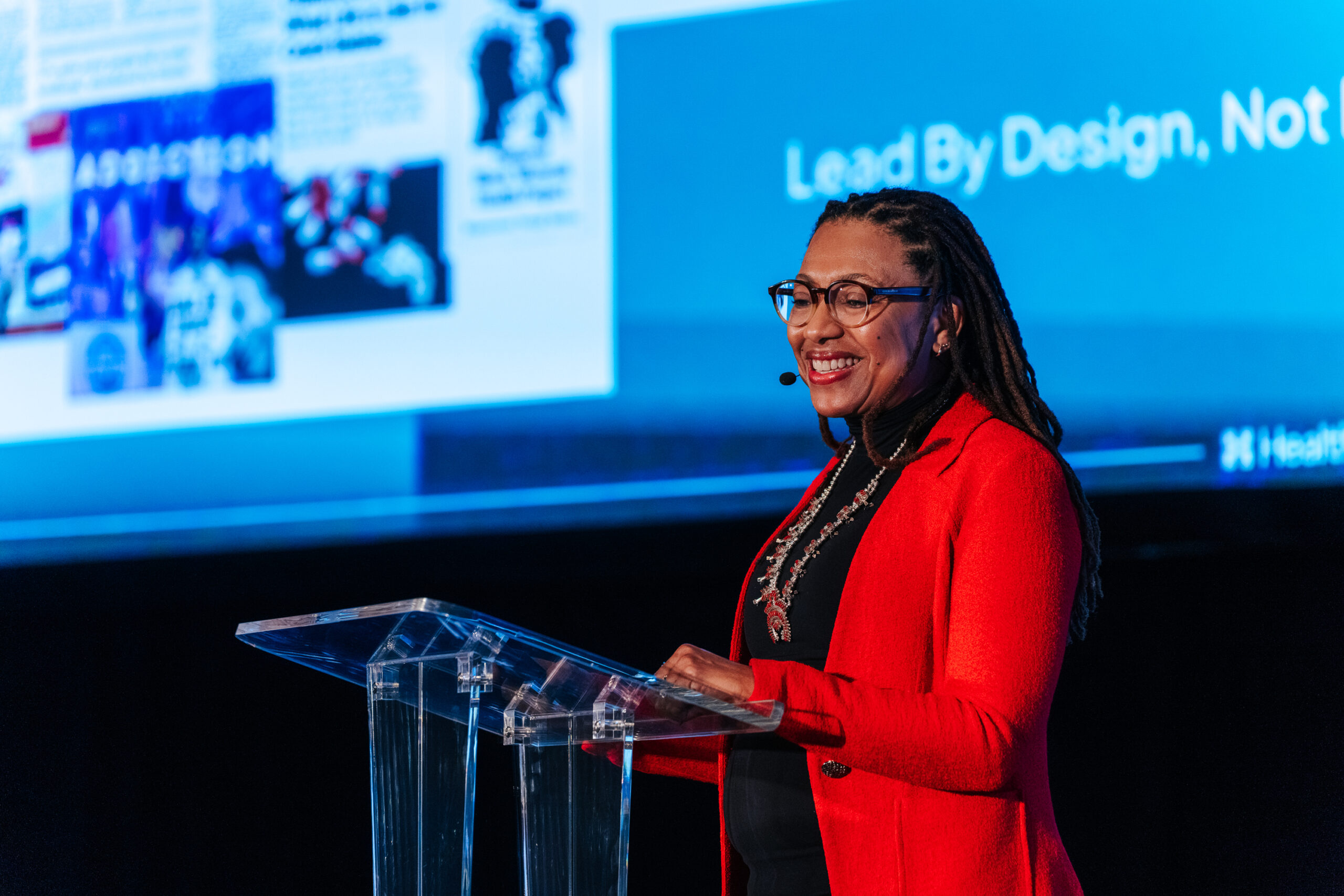
Nearly 80% of maternal deaths in Missouri were preventable between 2019 and 2023, which is a statistic that Dr. Dineo Khabele says reflects deeper problems in how health care is delivered.
During her HealthStack session, “Reducing Maternal Morbidity Through Inclusive Design,” Khabele, an obstetrician-gynecologist and academic leader, explored how racial disparities, geographic barriers and institutional practices contribute to maternal mortality.
Missouri recorded 31.2 maternal deaths per 100,000 live births during that period, compared with 61.9 among Black women — approximately 2.5 times the rate for white women.
“What is really galling and keeps me up at night is almost 80% of these deaths were preventable,” Khabele told attendees. “Let’s think about that. Almost 80% of these deaths were preventable.”
Leading With Design and Intention
Khabele became the first Black woman to chair her department at a St. Louis medical school in June 2020, shortly after George Floyd’s murder, amid nationwide protests against racial injustice.
“And so it was a really scary time, and I had to gather myself up and think about how I was going to lead in a place that was not quite ready for me,” she recalled.
Her approach centered on leading with design and intention, building on programs addressing underserved communities.
Khabele referenced the Rev. Martin Luther King Jr.’s observation: “Of all the forms of inequality, injustice in health care is the most shocking and inhumane.”
“If you take one woman out, especially in the Black community, who gets sick, who’s down, or who dies, that doesn’t just impact her immediate family,” Khabele explained. “It impacts an entire community.”
“But I don’t want to put it all on the individual woman,” Khabele continued. “There’s something wrong with where we live. We cannot ignore these facts. Geography makes a big difference in whether we’re going to get optimal care or not.”
Where You Live Can Determine Your Care
In St. Louis, she highlighted the Delmar Divide, a longstanding marker of racial and economic segregation. An EF3 tornado struck predominantly Black neighborhoods north of Delmar Boulevard, compounding decades of redlining and unequal investment.
Rural communities face different but equally significant challenges. According to 2025 March of Dimes data, 51.6% of Missouri counties are maternity care deserts, compared with 35% nationally.
“They don’t have an OB-GYN,” Khabele explained. She continued, “They don’t have a midwife. They don’t have a family medicine doctor who practices, who delivers or helps to birth babies.”
“This is a major problem, because we have access issues in the city and then we have access issues in rural areas,” she added.
She described patients arriving in labor at hospitals without obstetric services, leaving emergency physicians scrambling to arrange specialized care.
Using Technology to Bring Care Closer
Khabele outlined how remote blood pressure monitoring, digital ultrasound imaging and telehealth could help close those gaps.
Her health system has provided blood pressure cuffs to pregnant and postpartum patients at risk of hypertension, while training rural sonographers to capture ultrasound images for specialists in St. Louis to interpret remotely.
“The patient does not have to travel to us to get that resource,” she explained.
The approach offers rural health systems a model for expanding specialized maternal care without requiring patients to travel long distances for every consultation.
But, technology alone cannot correct harmful assumptions embedded in clinical care. Recalling her medical training during the HIV/AIDS and crack epidemics, Khabele described hospitals separating newborns from their mothers because clinicians incorrectly believed babies experiencing withdrawal should not be touched.
“I want y’all to think about that for a moment,” she told attendees, recalling nurseries filled with crying Black and brown infants who were not being held.
Her account illustrated the consequences of misinformation in clinical practice, contrasting with the multidisciplinary, family-centered approach she later described.
A Care Model Keeping Families Together
Khabele highlighted the Clinic for Acceptance, Recovery and Empowerment, or CARE, which treats pregnant patients experiencing opioid and other substance use disorders.
Its interdisciplinary team includes high-risk obstetric specialists, psychiatrists, infectious disease specialists, nurses, social workers and peer counselors. According to Khabele, 98% of patients arrive with active substance misuse. Most enter treatment by delivery and retain custody of their children.
“So this clinic has treated over 300 families,” she told attendees, reporting a “70% decrease in foster care placements.”
The results illustrate how integrating obstetric care, addiction treatment, mental health services and social support can help health systems address substance use during pregnancy while keeping families together.
Khabele questioned how the model could reach patients outside major medical centers, including rural Black communities often overlooked in maternal health discussions. Her recommendations included expanding community-based services, supporting doulas, improving prenatal access and maintaining postpartum follow-up for 12 months.
“We need individual, institutional and societal commitments,” Khabele concluded.

