
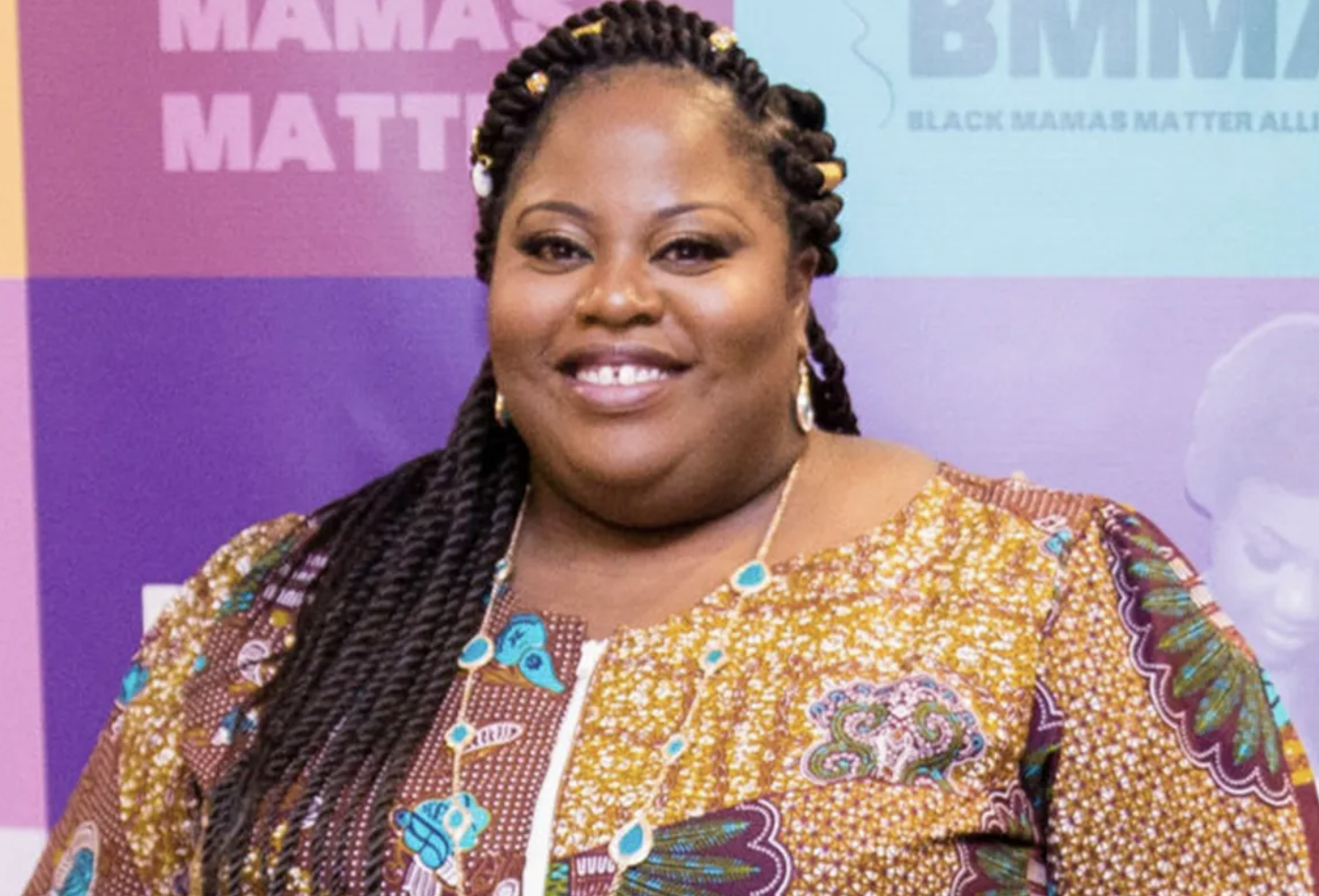
Angela Doyinsola Aina has spent two decades working to improve public health outcomes in Black maternal health.
Over 18 years working across academia, state agencies and federal institutions gave Aina a distinct perspective on public health. Throughout her career, she noticed a recurring, painful dynamic: community workers doing the heaviest lifting were routinely underpaid and overlooked. This reality, alongside a commitment to Black maternal health, pushed Aina to establish a nationally recognized women’s health organization.
“What motivated me personally was not only the crisis itself,” she tells HealthStack. “It was watching how Black and African women scholars, leaders, midwives, doulas and organizers were expected to carry this work without the resources to sustain it.”
“Our care work and our healing work have always been undervalued, and that undervaluing is not incidental,” she adds. “It is structural, and it is economic.”
As co-founder of the Black Mamas Matter Alliance, Aina is reshaping how the nation addressed the Black maternal health crisis. Her work addresses structural barriers affecting Black women and birthing people through advocacy, research, workforce development and community organizing.
She explains, “The through line of my career is the conviction that Black women’s leadership is essential and that it must be valued and resourced accordingly.”
How Black Feminism And Pan-Africanism Shaped Aina’s Approach To Maternal Health
Aina’s path into public health began with a focus on the why. Rather than looking exclusively at health outcomes, she became drawn to the broader forces shaping health and well-being.
“What drew me in was that public health was more expansive than medicine,” Aina shares. “It gave me language for health justice and social justice, and a way to think at the level of populations, environments, ecosystems and behaviors rather than individual pathology alone.”
As the eldest daughter of Nigerian immigrants, Aina’s lived experience cultivated her decision to pursue maternal health and community advocacy.
“Being the eldest daughter of Nigerian immigrants is part of what informs that, and Nigeria remains one of the countries with the highest maternal mortality rates in the world,” she explains. “That is why my work is grounded in Black and Pan-African feminisms and womanisms, and why you see those principles and values interwoven into the work of BMMA and into how we operate.”
Aina’s studies expanded to include African American studies, women’s studies and psychology. She shares that a foundation in Black American feminism, African studies, pan-Africanism and womanism shaped the platform she would go on to build.
In 2015, Aina helped launched BMMA. It began as a collaboration between the Center for Reproductive Rights and the SisterSong Women of Color Reproductive Justice Collective. Following their first gathering at MotherHouse in Atlanta’s historic West End, the initiative evolved into an independent national organization. Today, BMMA is a national network led by Black women that works to advance Black maternal health.
On The Strategy Behind Advancing Maternal Health Equity
BMMA has helped drive national cultural shifts in Black maternal health. It established the nationally recognized Black Maternal Health Week and launched the first Black Maternal Health Conference and Training Institute. The organization has also raised millions of dollars to support Black women-led organizations and strengthen the maternal health workforce.
Under the current administration, the fight for maternal health equity increasingly plays out through state policy and legal battles. As these battles move into courtrooms, Aina has positioned BMMA as a leading national voice.
“As for the path to progress, I would describe it as simultaneous rather than sequential,” Aina says. “Policy, workforce, research, and narrative have to move together, because each stalls without the others. But the organizing principle is simple: Follow the lead of the people closest to the harm, who are almost always the people closest to the solution, and then actually resource them.”
“We do not have a shortage of solutions in this country,” she continues. “We have a shortage of political will and investment.”
Aina’s says strategy for maternal health equity cannot solely hinge on court decisions. She says when the courts shut the door on the state level, her response is to “organize and widen the coalition.”
“We keep organizing the workforce itself, because Black midwives, doulas, community-based organizations, and birth centers are the most credible voices in this fight and they have to be resourced to stay in it,” she says.
Confronting The Systems That Undermine Black Maternal Care
Currently, BMMA’s attention is challenging the institutional barriers that restrict community-based care. Their focus is on the South where provider shortages and maternity care deserts disproportionately Black mothers.
“The impact on Black midwives and Black birthing people in the South is direct,” Aina says, pointing to Alabama, a state with severe provider shortages and widespread maternity care deserts.
These gaps have contributed to dire outcomes in rural and Southern communities. She explains that birth centers and community-based midwifery are often among the few accessible hubs within these communities. Yet, Southern state regulations often make it difficult for these facilities to remain open.
For Aina, these barriers also reflect a much longer history of displacement. Aina traces some of these barriers to the systematic displacement of Black midwives in the early 20th century. Organized medical and hospital trade organizations worked to discredit apprenticeship-trained midwives, many of whom were Black women. The shift away from community-based care, she says, continues to negatively affect Black access to maternity care today.
“We are still living inside the consequences of that decision,” Aina says. “The maternity care deserts we talk about today are not an accident of geography. They are the downstream effect of dismantling the Black midwives, granny midwives, and community-based practitioners who were already there.”
On Ending Black Maternal Mortality
For Aina, addressing historic and persistent barriers means aggressive systemic changes. She points to the current birthing model, noting that it is failing expecting Black and indigenous mothers across all socioeconomic classes.
“The model that has largely failed is one where midwifery is folded into a hospital system, subordinated to physician authority, stripped of its philosophy of care, and reduced to a staffing solution for an obstetric shortage,” she explains.
Aina says BMMA is working to bridge professional divisions to make way for a dual system. The organization is building a cross-disciplinary coalition that connects community-based birth workers and medical associations towards the same goal of improving maternal health outcomes.
“We also need entities that have not historically shown up to get behind this work,” explains Aina. “We need physician associations, nursing associations, hospital associations, public health institutions, and professional societies to say clearly that community birth settings and the full scope of midwifery care are legitimate, evidence-based components of a maternity care system.”
“When a court or a legislature sees a coalition that spans cross-sector stakeholders and the full range of the perinatal workforce all saying that we want holistic maternity and reproductive health care, that applies a kind of pressure that advocacy organizations cannot generate alone,” she adds.
Reshaping Maternal Health System
One of BMMA’s central priorities is changing the licensing standards and laws that determine who is credentialed to provide care. BMMA is also pushing for reimbursement pathways to ensure birthing practitioners can sustain their work and communities.
“Who gets trained, who gets licensed, and who is permitted to practice at the full scope of their training remains one of the most powerful levers in this field,” Aina explains. “This is why we push for legislation, particularly in Georgia, that allows midwives of all backgrounds to practice fully, whether they are certified nurse midwives, certified professional midwives, community-based midwives, or direct-entry midwives.”
Aina explains that BMMA’s challenge to restrictive credentialing is not a rejection of professional standards. The organization is addressing a system in which historically discriminatory standards determine whose expertise counts.
“I want to be clear that BMMA believes in standards,” she says. “We support rigorous training, accreditation, and licensure. Our position is about who builds those standards.”
Adding Equity To Credibility
Currently, Aina’s organization is advocating for recognition and licensure for certified professional midwives and traditional birth attendants across states. She also hopes to reshape standards to recognize the expertise of Black, Indigenous and community-based practitioners.
“When Black, Indigenous, and the communities most affected are not at the table when standards are written, the result is a process full of barriers rather than one that ensures quality,” she explains.
“This is a major reason we do not have enough licensed midwives, doulas, and lactation consultants in our communities,” continues Aina. “Licensure, accreditation, and scope of practice are reproductive justice issues, and they are decided mostly at the state level, where far fewer people are paying attention.”
As of July 2026, only 22 states and Washington, D.C., provided Medicaid coverage for certified professional midwives or certified midwives. Aina believes this underscores how much work remains at the state level to expand access and support the maternal health workforce.
While she has spent much of her career advocating for the Black diaspora and birthing rights, she is also learning, as many ambitious women do, to extend that same care to herself.
She says, “I am still learning to apply what I advocate for publicly to my own life, to be more intentional about my time, and to actually practice rest rather than just recommend it.”

